Introduction
AI and human jobs are no longer a theoretical debate. In 2026, automation is embedded into marketing, healthcare, finance, logistics, and even creative industries. Businesses across the United States are adopting intelligent systems to improve efficiency, reduce costs, and scale operations.
At the same time, workers are asking a pressing question:
Are machines replacing people—or redefining what people do?
The answer is more balanced than most headlines suggest. The real winners are not AI systems or humans alone, but those who understand how both can work together.
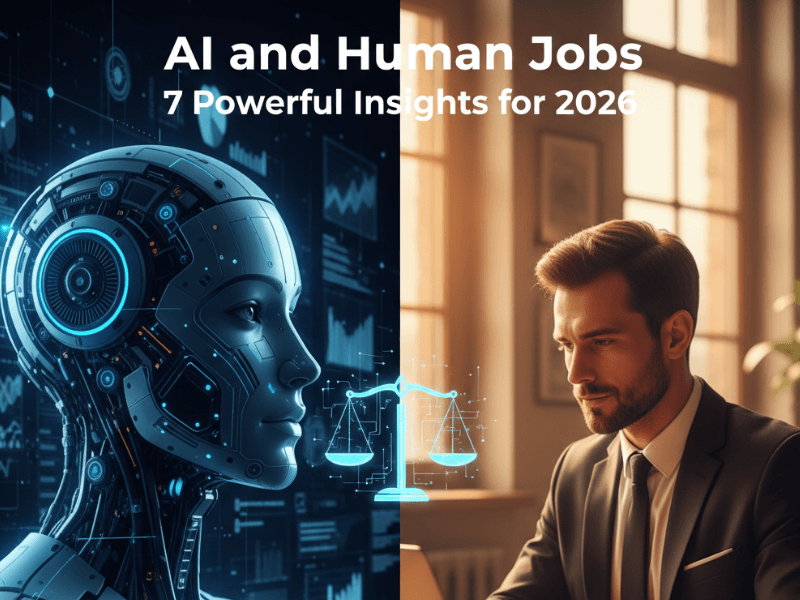
The Battle Between AI and Human Jobs
The debate over AI and human jobs has become one of the most talked-about topics in 2025. Artificial intelligence has entered nearly every workspace—from offices and factories to classrooms and hospitals. The question everyone is asking is, will AI replace humans, or will it empower them?
At ExploreAIHub, the tour goal is to make this transformation easier to understand. We believe the future isn’t about humans versus machines but about how both can work together to create more meaningful results.
How AI Is Changing the Nature of Work
AI has already transformed industries like finance, healthcare, logistics, and education. Tasks that once required hours of manual effort are now completed in seconds using automation and machine learning tools.
A McKinsey report suggests that by 2030, nearly 30% of all work activities could be automated. But it’s not all bad news. Rather than eliminating jobs, AI is reshaping them—creating demand for new skill sets such as data analysis, prompt engineering, and AI-driven decision-making.
In fact, many professionals now use AI tools like ChatGPT and Copilot to increase their productivity. Platforms such as Explore AI Hub offer free tutorials and resources to help people adapt to these changes.
AI vs Human Strengths (Comparison Table)
| AI Strengths | Human Strengths |
|---|---|
| High-speed data processing | Emotional intelligence |
| Pattern detection | Ethical reasoning |
| 24/7 availability | Creative thinking |
| Scalable automation | Leadership |
| Predictive modeling | Adaptability |
Why Human Intelligence Still Matters
While AI excels in speed and data accuracy, human intelligence adds creativity, empathy, and critical thinking—qualities machines simply can’t replicate. Employers in 2025 value workers who can combine technical knowledge with emotional understanding.
A World Economic Forum report found that roles requiring social and analytical skills — like teachers, therapists, and designers — are far less likely to be automated. The most successful professionals are those who learn to use AI as a tool rather than fear it.
If you want to explore how to integrate AI tools into your daily workflow, you can read our detailed guide on ChatGPT productivity hacks.
Top Industries Impacted by AI in 2025
The influence of AI and human jobs varies across sectors. Here’s a snapshot of how industries are evolving:
| Industry | AI Impact | Human Role |
|---|---|---|
| Healthcare | High | Doctors rely on AI diagnostics, but empathy and communication remain irreplaceable. |
| Education | Medium | AI assists teachers in grading and content creation, but personal mentorship is human-driven. |
| Finance | Very High | AI analyzes risk and fraud, yet ethical decision-making remains human. |
| Technology | Extremely High | Developers use AI tools to code faster, but creativity drives innovation. |
The takeaway? AI is not the enemy—it’s an accelerator. Humans who adapt will thrive in this blended environment.
The Future: Collaboration Over Competition
The most successful companies are already proving that AI and Human Jobs can coexist. For example, hospitals use AI to detect diseases faster, but human doctors interpret the emotional and ethical implications. Similarly, teachers use AI-based learning platforms to personalize lessons but still build real connections with students.
This kind of AI-human collaboration boosts efficiency while keeping the emotional core intact. It’s what experts call a hybrid intelligence model — where machines handle precision tasks and humans lead with purpose.
As mentioned on Explore AI Hub, the smartest approach is to treat AI as your teammate, not your rival.
How to Stay Relevant in the AI-Driven Job Market
The rise of AI doesn’t mean you’ll lose your job — it means you’ll need new skills. Here’s how to future-proof your career:
- 🧠 Learn to use AI tools – Start with simple tools like ChatGPT or Midjourney.
- 💻 Focus on creativity and problem-solving – These skills can’t be automated.
- 📈 Keep learning continuously – AI evolves fast; so should you.
- 🌐 Follow trusted sources – Websites like Explore AI Hub and the World Economic Forum regularly share the latest AI trends and insights.
Remember, adaptation is your superpower in the evolving world of AI and human jobs.
Money & Earning Guide
Income trends in 2026 reflect skill positioning.
Roles Facing Pressure
1) Basic administrative support
2) Entry-level bookkeeping
3) Simple content production
Wages in these areas may stagnate.
Growing Opportunities
1) Automation consultants
2) AI implementation specialists
3) Data analysts
4) Cybersecurity experts
5) Strategic content creators
Estimated U.S. income ranges:
1) Automation consultant: $90,000–$150,000 annually
2) Data analyst: $75,000–$130,000 annually
3) AI-focused freelancer: $3,000–$12,000 per month
Mistakes to Avoid
1) Ignoring skill upgrades
2) Depending on a single outdated service
3) Avoiding exposure to automation tools
4) Assuming technology replaces all human roles
Those who combine intelligence with strategy increase earning potential
Pros & Cons
Advantages of AI Integration
1) Increased productivity
2) Reduced operational costs
3) Expanded remote work options
4) Faster business decisions
5) Greater scalability
Challenges
1) Skill displacement in repetitive jobs
2) Continuous learning requirements
3) Ethical considerations
4) Overreliance on automation
Awareness and adaptability reduce risk.
Final Thoughts: The Real Winners of the AI Era
So, who wins in the competition between AI and human jobs? The truth is everyone who chooses to evolve. AI isn’t here to destroy careers; it’s here to redefine them.
Companies will continue to rely on human creativity, communication, and ethics—qualities that no algorithm can truly replicate. Those who embrace AI as a collaborator, not a competitor, will lead the future workforce.
At Explore AI Hub, we’re dedicated to helping you master this balance. From tutorials on AI tools to guides on digital productivity, our mission is to prepare you for the next decade of transformation.
The real winners are not robots or humans — they’re the humans who know how to use robots wisely.
